Pricing Assumable Debt on a Multifamily Sale
Summary. Brokers agree that a building carrying a 2021 agency loan is worth more than the same building without one, and that buyers should pay "less than the full value of the interest saving." Nobody publishes the number. Fannie Mae and Freddie Mac loans are assumable with lender approval and a fee of about 1% of the balance, and Northmarq reports that deals with assumable debt and remaining term "continue to draw interest." The premium itself is left to negotiation.
This note computes it. We take the representative $24M building from our earlier notes, give it a 65% agency loan written in late 2021 at 3.75% with five years left, and ask what a buyer can pay above today's market value and still earn the same return as a buyer using new debt at 7.22%. Findings:
The mechanics. Fannie Mae and Freddie Mac multifamily loans can be assumed by a buyer the lender approves, for a fee commonly around 1% of the loan balance plus legal and processing costs. Approval runs 45 to 90 days and tests the buyer's net worth, liquidity and operating record against the lender's standards; the property is re-underwritten at the same time. Freddie Mac's supplemental loan sheet allows a second loan behind an assumed first only if three or more years remain on the first.
The demand. Northmarq's 2026 outlook lists "transactions supported by assumable debt or conservative leverage" among the places capital is showing up most consistently, "particularly when they improve leverage and execution certainty." Matthews describes assumable loans and seller carrybacks as the structures through which deals are clearing the gap between buyer and seller expectations.
The rules of thumb. A Marcus & Millichap broker's guide to buying with assumable debt says a remaining term of eighteen months is "close to worthless," that "five or more years is where the value concentrates," and that a buyer should pay less than the full interest saving, with the benefit split with the seller. Those are the right instincts. None of them is a price.
The vintage. The ten-year Treasury averaged 1.36% in the second half of 2021. At the 200 bp agency spread we use throughout these notes, a ten-year fixed loan written then carried a coupon in the mid-3s. We use 3.75%, the figure from our negative leverage note, and show 3.25% and 4.25% alongside it.
The building is the one we have used since September: bought for $24M in Q4 2021 at a 4.7% cap, NOI now $1.24M after 10% growth, worth $21.6M at today's 5.75% transaction cap rate. This time the seller financed it with a ten-year fixed agency loan rather than a bridge loan.
| Assume the 2021 loan | New agency debt today | |
|---|---|---|
| Coupon | 3.75%, fixed | 7.22% (10-year 5.22% + 200 bps) |
| Loan amount | $14.1M (balance of a $15.6M loan after five years) | $12.2M (1.25x DSCR on in-place NOI) |
| Loan-to-value at $21.6M | 65% | 56% |
| Annual debt service | $867K | $992K |
| DSCR on in-place NOI | 1.43x | 1.25x |
| Equity at $21.6M | $7.7M, including a $140K assumption fee | $9.4M |
| Year-1 cash-on-cash | 5.4% | 3.0% |
| 5-year levered IRR | 14.7% | 9.6% |
Both buyers hold five years, to the loan's maturity, grow NOI at 3% and exit at a 6.00% cap with 2% selling costs. The assuming buyer repays the loan at par at maturity, so there is no prepayment cost. The new-debt buyer pays off a loan with five years of amortization.
The gap is two things, not one. The coupon difference is 347 bps on $14.1M, or $488K in the first year. But the assumed loan is also $1.9M larger than any lender would write today, because it was sized against a 2021 coupon. The buyer puts in $1.8M less equity and earns a 5.4% cash yield on it instead of 3.0%. At market price, assuming the loan is worth about 510 bps of IRR. Re-running the deal with the new loan's size at the old coupon isolates the rate: 375 bps. The remaining 135 bps is the extra leverage.
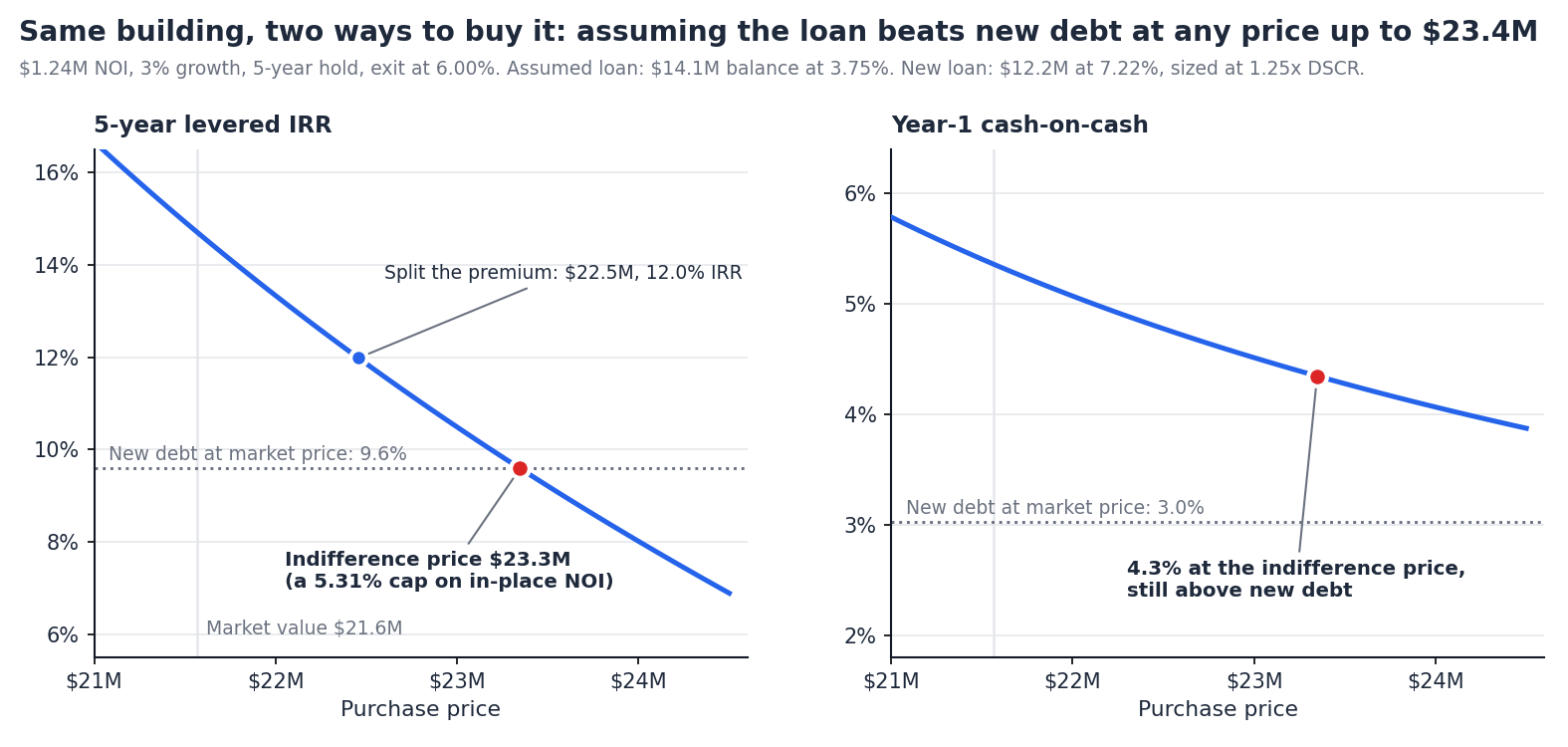
The question for the buyer is how much of that 510 bps to hand to the seller. The ceiling is the price at which the assuming buyer's IRR falls to the 9.6% the new-debt buyer earns at market. We solve for it directly.
$23.35M, a $1.78M premium. At that price the building trades at a 5.31% cap on in-place NOI, 44 bps inside the market. The buyer's equity is $9.4M, the same as the new-debt buyer's, and the IRR is the same. Year-one cash-on-cash is still 4.3% against 3.0%, because the cheap loan front-loads the benefit; the new-debt buyer catches up through a smaller exit payoff.
Against the interest saving. The present value of five years of coupon saving on the declining balance, discounted at the new-debt rate, is about $2.0M. The IRR-matching premium is $1.78M. The difference is the assumption fee and the fact that the buyer's cheaper equity is spread over a larger check. A seller who quotes the full interest saving is asking for more than the loan is worth to any buyer.
Where the split lands. The broker guidance is that the benefit is shared. At the midpoint, $22.5M, the buyer earns a 12.0% IRR and a 4.8% cash yield, 240 bps and 180 bps better than new debt, and the seller nets $0.9M more than a market sale. Either side can see what it is giving up.
| Input | Low | Base | High |
|---|---|---|---|
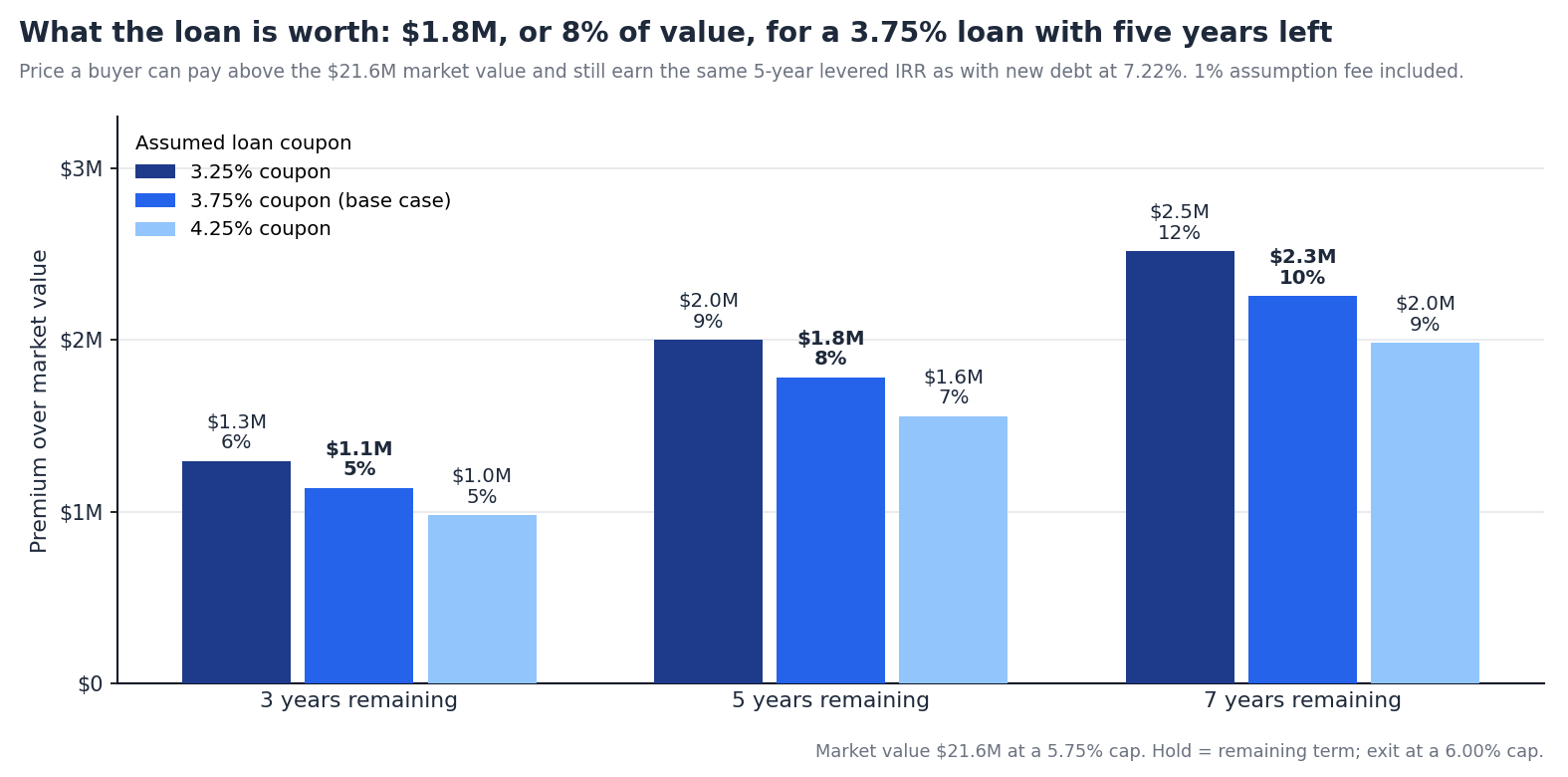
| Remaining term | 3 years: $1.1M (5%) | 5 years: $1.8M (8%) | 7 years: $2.3M (10%) |
| Coupon on the assumed loan | 4.25%: $1.6M | 3.75%: $1.8M | 3.25%: $2.0M |
| 10-year Treasury today | 3.97% (Feb 27): $0.9M | 5.22% (Oct 8): $1.8M | 5.75%: $2.1M |
| Assumption fee | 2%: $1.6M | 1%: $1.8M | None: $1.9M |
Term dominates. Each year of remaining term is worth about $0.3M on this deal. A loan with eighteen months left is worth a few hundred thousand dollars, which is why the broker rule of thumb calls it close to worthless: it does not survive the 45 to 90 days of approval, the fee, and the cost of refinancing at the far end.
The coupon matters less than it looks. A full point of coupon moves the premium by $0.45M. The reason is that the leverage effect is unchanged by the coupon: a 4.25% loan is still $14.1M against a market that will lend $12.2M.
The index sets it. The premium is a function of the spread between the old coupon and the new one. In February, with the ten-year at 3.97%, the same loan was worth $0.9M. Today it is $1.8M. If last week's standoff between sellers at 5.75% and buyers who cannot make new debt work continues, this is the asset class in which it resolves, because the seller holding the cheap loan has something to sell besides the building.
Three things follow.
The loan is a line item, and it should be priced as one. A listing that says "assumable agency debt, 3.75%, five years remaining" is quoting an asset worth 8% of the building. The OM will not say so. The buyer's model should, by running the deal both ways and taking the difference, before the first call rather than in the negotiation.
Approval risk is the buyer's, so the premium should be contingent. The lender can refuse the buyer, and 45 to 90 days is long enough for the index to move. A purchase agreement that pays the premium only on approval, and reverts to a market price with a new-debt fallback if the assumption fails, is the structure the arithmetic supports.
For sellers, this is the alternative to the refinance gap. Last week's note priced an owner with a 2021 bridge loan at a $5.9M shortfall. An owner with a 2021 agency loan is in the opposite position: a buyer will pay $1.8M for the loan that the owner could not otherwise monetise, and the sale clears without a capital call. Which side of that line an owner is on was decided by the financing choice in 2021, not by anything since.
The model is simple: full amortization from origination, no interest-only period, no supplemental loan, no prepayment on the new debt at exit, and the same exit cap for both buyers. A supplemental loan behind the assumed first would raise the premium; a shorter hold than the remaining term would lower it.
Teez runs a deal under its in-place debt and under new debt from the same inputs, sizes the new loan from the DSCR constraint, and solves for the price at which the two match, so the value of the loan is on the page next to the value of the building. More at teez.ai.